White-Label Meeting Platform Alternatives
WebMeet® Solutions
White-Label Meeting Platform Alternatives:
Comparing BigMarker, MegaMeeting, Digital Samba, and More
Somewhere in your organization right now, distributors are logging into a meeting platform that isn’t yours — branded with someone else’s logo, priced on someone else’s tier structure, subject to someone else’s roadmap. If you’ve started researching white-label meeting platform alternatives, you’ve probably noticed the market doesn’t make the choice easy: every vendor claims to be “fully customizable,” every pricing page hides the number that actually matters behind a “contact sales” button, and no two platforms are solving the same problem the same way.
That’s not an accident. The white-label meeting space isn’t really one category — it’s four different business models wearing the same marketing language. Before you compare a single feature checklist, it’s worth understanding which model you’re actually being sold, because that decision matters more to your organization’s long-term cost and control than any individual feature ever will.
Four Ownership Models, Not One Market
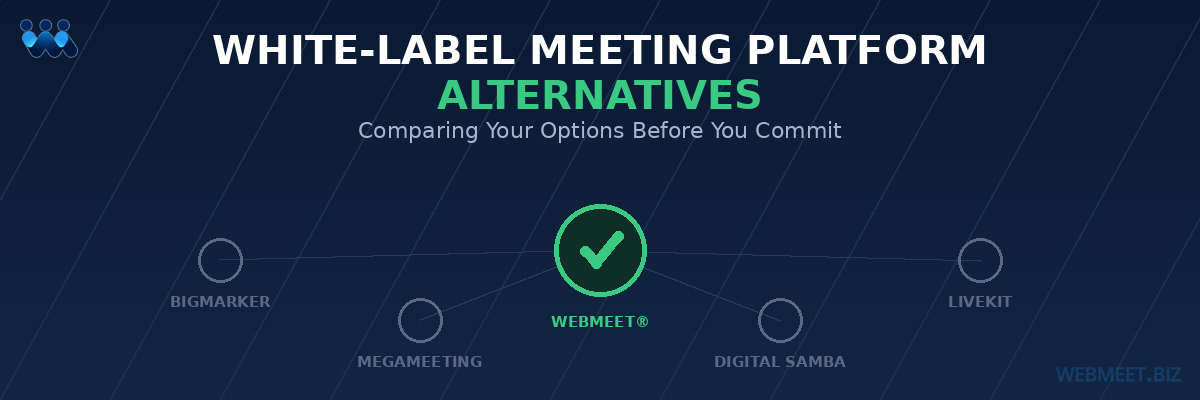
Every platform in this space falls into one of four categories, and knowing which one you’re looking at changes the entire conversation:
● Subscription SaaS webinar platforms (BigMarker, MegaMeeting) You rent access at a tier, and white-label branding is typically an upsell within that tier structure.
● Embedded API/SDK platforms (Digital Samba) Built for developers to integrate video into their own application, priced on capacity and usage, hosted entirely in the vendor’s cloud.
● Open-source infrastructure (LiveKit) A genuinely powerful media engine you can self-host for free, but it’s raw infrastructure, not a finished product. You, or a development team, still have to build the meeting rooms, the branding system, the compliance controls, and the presenter tools on top of it.
● Owned licensed infrastructure (WebMeet®) A complete, purpose-built white-label product that deploys into your own AWS account, so your organization owns the deployment rather than renting a seat in someone else’s. The platform is escrow-backed, SOC 2 ready, and open to per-licensee customization.
With that framework in mind, here’s how each of the named platforms actually stacks up.
BigMarker: Webinar-First, White-Label as an Enterprise Add-On
BigMarker is a webinar and virtual-events platform with on-demand sessions, broadcast tools, and a wide integration catalog. Its pricing runs through tiered plans (Basic, Plus, Elite, Summit) scaled by attendee capacity and host seats. White-label branding and custom domains sit in a separate Enterprise+ tier that’s quote-based rather than published, meaning the actual cost of presenting fully under your own brand isn’t fixed until you’re deep into a sales conversation.
For a network marketing organization, that’s worth flagging early: the platform your field presents under is a negotiated add-on, not the foundation the product is built around.
Two more things worth flagging: BigMarker does not publicly document software escrow or continuity protection for your platform, and per-licensee customization is limited to a shared feature-request queue — not builds exclusive to your brand.
MegaMeeting: An Established Name With a Narrower White-Label Path
MegaMeeting, built on WebRTC and AWS, with HIPAA-compliant options and a documented white-label agreement. Its white-label path runs in two steps: a co-branded subdomain (yourcompany.megameeting.com) at a lower tier, or a fully private domain (meeting.yourcompany.com) as a separate upgrade. Pricing is seat-based on monthly or annual subscriptions, with enterprise pricing requiring a custom quote.
MegaMeeting’s white-label option is real and has been in market for years, but like BigMarker, it’s structured as a tier you unlock rather than infrastructure your organization owns outright.
Two more things worth flagging: MegaMeeting does not publicly document software escrow or continuity protection, and there’s no documented path for per-licensee custom development at all.
Digital Samba: Strong on European Compliance, Cloud-Only by Design
Digital Samba is a European Union–based platform built around GDPR compliance, end-to-end encryption, and full white-labeling through its Embedded API SDK product — including custom domains (C NAME support), webhook access, and branded registration pages. Its pricing is capacity-based rather than per-seat, with published estimates suggesting business-tier plans starting in the range of a few hundred dollars per month, scaling with enterprise usage.
The tradeoff is architectural: Digital Samba is cloud-only. There’s no self-hosting option, so your organization’s meeting infrastructure runs entirely on Digital Samba’s servers, on Digital Samba’s recurring pricing, for as long as you use the product. For organizations prioritizing EU data residency specifically, that may be an acceptable tradeoff — but it’s still a rented environment, not owned infrastructure.
Two more things worth flagging: Digital Samba does not publicly document software escrow or continuity protection beyond its own cloud infrastructure, and while its Embedded API lets you build your own customizations, there’s no vendor-side team building brand-specific features for you.
LiveKit: Powerful Infrastructure, But You Build the Product Yourself
LiveKit is a different animal entirely — an open-source, Apache-licensed WebRTC media server that major platforms use as the transport layer under their own products. It’s genuinely capable technology, and it’s free to self-host. LiveKit Cloud, the managed version, offers a free development tier plus paid tiers around $50 and $500 per month with usage-based overage on top.
Here’s the catch for a network marketing organization evaluating it as a white-label option: LiveKit is a media engine, not a meeting platform. There’s no branded room, no presenter controls, no compliance-locked content library, no distributor account system — you or a development team would need to build all of that from scratch on top of LiveKit’s transport layer. For an engineering-heavy company building a bespoke communications product, that’s a legitimate path. For a network marketing organization that needs a working, brandable meeting platform for its field this quarter, the build timeline and ongoing engineering cost make it the most expensive “free” option on this list.
Two more things worth flagging: LiveKit provides no vendor-managed escrow or continuity plan of any kind, and while you technically have full customization freedom, it comes with zero implementation support, your team builds and maintains everything.
Where WebMeet® Fits: Owned Infrastructure, Built for Network Marketing
WebMeet® occupies the fourth category almost by itself: a complete, purpose-built white-label meeting product — not a media engine you assemble, not a SaaS tier you rent — that deploys directly into your own AWS environment.
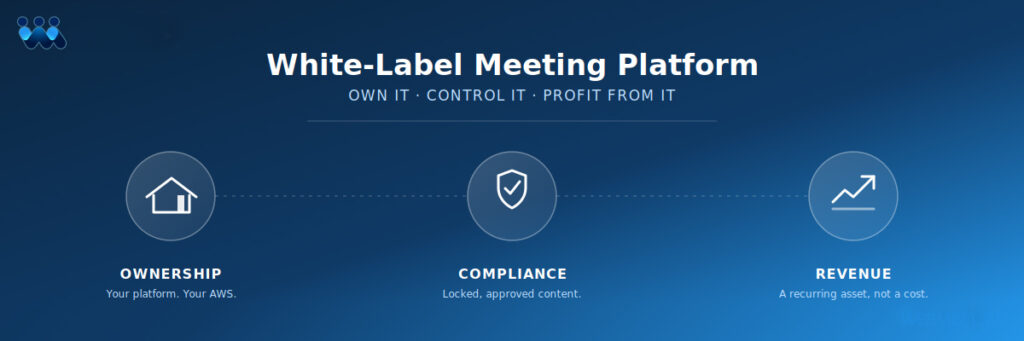
WebMeet® is an owned white-label meeting infrastructure platform that runs in your AWS, enables revenue generation, and includes optional software escrow for continuity protection.
That last piece — escrow — is the detail genuinely absent from every subscription competitor above. None of BigMarker, MegaMeeting, or Digital Samba publicly document a continuity mechanism for what happens to your organization’s meeting infrastructure if the vendor’s business changes direction.
WebMeet’s escrow provision exists specifically so your training system, compliance controls, and distributor accounts aren’t tied to a single vendor’s roadmap decisions — combined with running inside your own AWS account, that’s a structural safeguard most of the market simply doesn’t offer.
A Benefit No Other Competitor in This White-Label Meeting Platform Alternatives Roundup: Per-Licensee Custom Development
There’s one more distinction worth its own section, because it doesn’t show up on a typical feature checklist: what happens when your organization needs a change that’s specific to your brand and not a generic feature every other customer on the platform also gets.
Under WebMeet’s Master Licensee Agreement, a licensee can submit a feature or change request through a defined process. WebMeet’s engineering team scopes the request, provides a quote, and — once approved — implements that update exclusively into that licensee’s branded platform. It doesn’t get folded into a shared release that ships to every other licensee; it’s built for your deployment specifically.
That’s a meaningfully different model from everything else in this roundup. BigMarker maintains a public feature-request and roadmap board, but it’s a shared queue — requests that get built ship to the whole customer base at once, not to one company’s branded instance alone. MegaMeeting and Digital Samba don’t publicly document an equivalent per-client development process at all. And LiveKit’s open-source model actually grants full source code access to anyone self-hosting it — but that access comes with zero vendor-provided implementation; your organization would need its own engineering team to scope, build, and maintain any change.
WebMeet’s process sits in between those two extremes: you don’t need an in-house development team, and you’re not waiting on a shared roadmap vote either. As your distributor base grows and your compensation plan, training model, or international footprint evolves, your platform can evolve alongside it — *engineered specifically for your brand.
A Practical Framework for Evaluating Any Platform on This List
Rather than comparing feature checklists line by line, ask these six questions of any platform you’re evaluating — including WebMeet®:
● Platform dependency: Is your field’s training, presenting, and follow-up running through a system you control, or through Zoom, Teams, or a third-party tool your company doesn’t own?
● Brand control: When a prospect joins a meeting, whose brand are they actually stepping into — yours, or the vendor’s?
● Compliance and message control: Can corporate lock the approved decks and videos so distributors can’t alter or replace them, or does the platform simply trust everyone to stay on-message?
● Financial leakage: Is what your distributors already spend on meeting tools flowing to a third-party vendor, or back into your organization as a revenue stream?
● Continuity: If the vendor is acquired, pivots, or shuts down, does your organization have any contractual claim on the infrastructure your business runs on — or does the answer come down to “nobody built for that”?
● Growth flexibility: When your organization needs a change specific to your brand, is there a documented path to get it built — or are you limited to what a shared roadmap eventually ships to everyone?
Every platform above answers some of these questions well. Very few, other than WebMeet, answer all six.
White-Label Meeting Platform Alternatives:
Comparison at a Glance
Let’s walk through how each platform compares across five categories: model, pricing, white-label depth, continuity protection, and per-licensee custom development.
Platform | Model | Pricing | White-Label Depth | Continuity Protection | Per-Licensee Custom Dev. |
BigMarker | SaaS subscription | Tiered by attendee capacity/seats; white-label is a quote-based Enterprise+ add-on | Cosmetic branding at top tier | Not publicly documented | Shared feature-request board; no bespoke per-client builds documented |
MegaMeeting | SaaS subscription | Monthly/annual seat-based plans; co-branded or fully private domain as an add-on | Two tiers: co-branded subdomain or full private branding | Not publicly documented | Not publicly documented |
Digital Samba | Cloud SaaS / embedded API | Capacity-based tiers; reported starting around $400/mo for business tier | Full white-labeling, CNAME, API control on Embedded plans | Cloud-only; no self-hosting option | Not offered by vendor; customers build their own via Embedded API |
LiveKit | Open-source infra / DIY | Free self-hosted, or Cloud tiers ($0 / $50 / $500) plus usage | Unlimited — you build the product layer yourself | You own it entirely, but you also build and maintain it entirely | Full source access, but you scope, build, and maintain changes yourself |
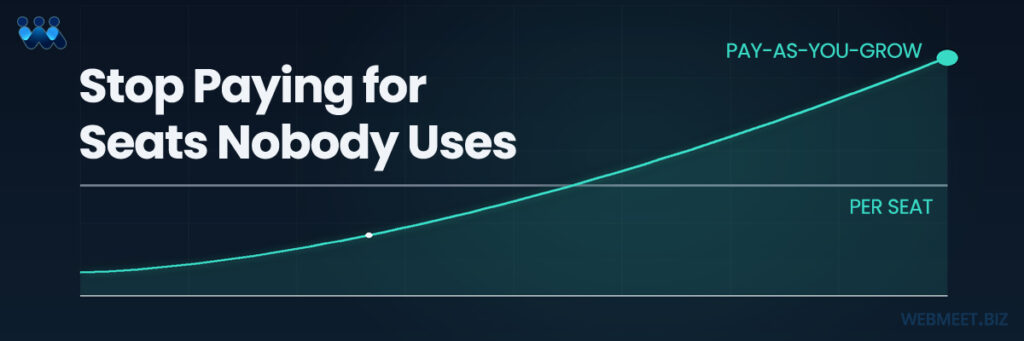
WebMeet® | Owned licensed infrastructure | Pay-as-you-grow, scaled to actual usage | Full white-label, deployed in your own AWS account | Optional software escrow for source code and infrastructure continuity | Documented request process under the Master Licensee Agreement: WebMeet engineers scope, quote, and build the update exclusively into your branded platform |
The Bottom Line
If what you actually need is a complete, brandable meeting platform — built specifically for the compliance, duplication, and continuity demands of a network marketing organization, and backed by escrow so your business isn’t dependent on one vendor’s decisions — that’s the gap WebMeet® was built to fill.
Schedule a strategy call today, and let’s talk about what a branded web meeting solution could do for your business. Click the Book a Strategy Call button below.
* This is a scoped, quoted service defined under the Master Licensee Agreement — not a guarantee of free, unlimited, or instant custom development. Specific terms, timelines, and costs are governed by that agreement.