The 40-Minute Wall How Free Plan Limits, Quietly Undermine Serious Meetings
WebMeet® Solutions
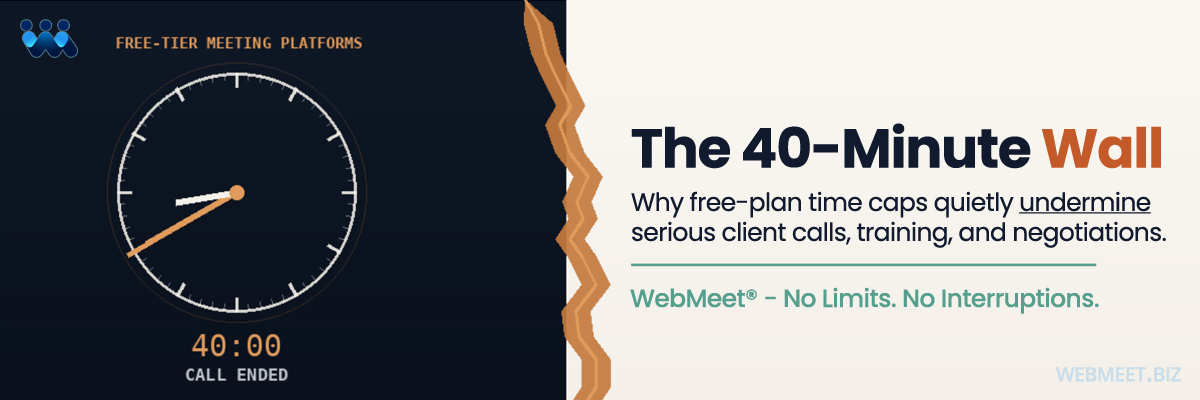
There’s a specific moment familiar to anyone who has run a longer call on a free video conferencing plan: the countdown warning, and then the call simply ends — mid-discussion, mid-negotiation, mid-training session — because the platform’s free tier caps group meetings at 40 minutes. Everyone has to reconnect, pick up the thread, and hope nothing important got lost in the gap.
It’s a deliberate upsell mechanism, and it works exactly as intended for casual use. But for any business trying to run real client conversations, training sessions, or webinars, it turns the meeting platform itself into a source of friction rather than a tool that gets out of the way. What should be a background utility becomes an active variable the organizer has to manage — watching the clock, wrapping up discussions prematurely, or scrambling to reconnect at the worst possible moment in a conversation.
The Ripple Effect of an Artificial Cutoff
The 40-minute cap doesn’t just interrupt the meeting in progress — it changes how people plan meetings in the first place. Organizers start artificially compressing agendas to fit inside the limit, cutting discussion short not because the conversation was finished but because the clock forced it. Training sessions get split awkwardly across multiple calls. Sales conversations that were building genuine momentum get cut off right as a prospect was asking real questions, forcing a follow-up call to recapture context that could have been resolved in the original conversation. None of that is a coincidence of scheduling — it’s a direct consequence of a pricing mechanism designed to create friction at the free tier.
Why It Happens
Free tiers on mainstream platforms exist to convert users into paid seats, so the limitations are engineered to be felt — time caps, feature gating, watermarks, and restricted participant counts are all designed to push usage past the point where the free plan is workable. That’s a reasonable business model for a self-serve consumer product. It’s a poor fit for any organization trying to deliver a polished, uninterrupted experience to a client or prospect, because the very friction meant to drive a conversion decision ends up degrading the experience of everyone still using the free tier while they decide whether to upgrade.
How WebMeet® Solves This
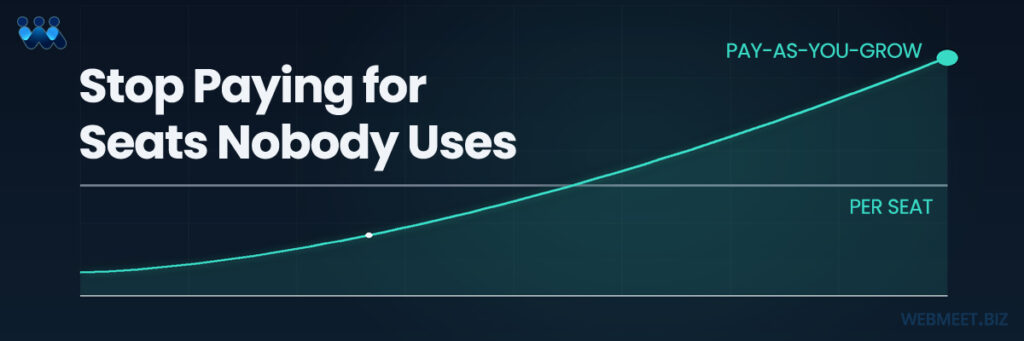
WebMeet® isn’t distributed as a freemium consumer product with artificial caps designed to force an upgrade. It’s deployed as licensed, white-label infrastructure directly into a licensee’s own AWS environment, with a pay-as-you-grow model built around actual business usage rather than deliberately restrictive free-tier gates. There’s no 40-minute wall built into the product to manufacture urgency — the platform is licensed to actually run your meetings, not to sample them in a deliberately limited form designed to create pressure toward an upgrade.
For enterprise licensees, that also means the meeting experience delivered to a client or trainee doesn’t carry the friction of an artificially constrained plan tier. The room, the content, and the session length are set by the licensee’s needs, not by a growth-hacking mechanism baked into the pricing page. A training session runs as long as the training actually requires. A negotiation runs as long as the conversation needs to reach a resolution. Neither is subject to an external clock designed by a vendor trying to convert a different category of user entirely.
Why the Distinction Matters Long-Term
Businesses evaluating meeting platforms often underestimate how much a pricing structure shapes daily behavior long after the initial purchase decision is made. A cap that seemed minor during a vendor comparison spreadsheet review becomes a daily operational annoyance once the platform is actually in use across dozens of meetings a week. The cost of that friction isn’t captured anywhere in the sticker price — it shows up later, in the form of interrupted conversations and rescheduled follow-ups that a licensing model without artificial gating would have avoided entirely.
What This Means in Practice
The absence of an artificial time limit isn’t just a convenience — it changes what kinds of meetings an organization can confidently schedule on the platform in the first place. Long-form training sessions, extended onboarding walkthroughs, and in-depth client reviews can all be planned without factoring in a mid-session interruption risk. That removes a planning constraint that otherwise shapes how meetings get structured well before they even start, freeing organizers to design the agenda around what the conversation actually needs rather than around what the platform will tolerate.
There’s also a credibility dimension worth noting. A client or prospect who’s experienced the abrupt free-tier cutoff on a different platform brings that memory into every subsequent meeting, half-expecting the same interruption. A platform that’s never introduced that friction in the first place doesn’t have to overcome that expectation — the meeting simply runs, uninterrupted, for as long as it needs to.
The Bottom Line
A meeting platform shouldn’t be designed to interrupt you. WebMeet’s licensing model is built around supporting real usage, not manufacturing scarcity to drive upgrades — because the platform was never meant to be sampled in a deliberately limited form in the first place.