More Than a Reseller Video Conferencing Platform
If you’re researching a reseller video conferencing platform, you’re probably picturing something specific: a bulk license, a discounted rate, a logo swapped onto someone else’s product so you can sell it under your own name. That’s a real category, and it’s worth knowing upfront that it’s not what this is. A typical reseller arrangement still leaves the underlying vendor holding the infrastructure, the data, and often a piece of the revenue. What network marketing companies actually get with WebMeet® goes further than that: their own brand, their own billing relationship, exclusive access to their own customer data, and a hosting environment they control outright — with software escrow available as an option they can add at any point in the relationship, not just at signup.
What “Reseller” Usually Means — and Why It Falls Short
In a typical reseller model, the vendor stays firmly in the middle. They process the payments, they store the customer data, they host the infrastructure, and the “reseller” is really just a sales channel earning a markup or a commission on someone else’s product. That arrangement can work, but it caps how much control — and how much of the value — actually belongs to the company doing the selling.
WebMeet® was structured to avoid that ceiling entirely. Licensees aren’t reselling WebMeet®’s service under WebMeet®’s name or through WebMeet®’s infrastructure. They’re operating their own branded platform, deployed in their own environment, sold entirely on their own terms. The word “reseller” doesn’t really capture that — it undersells it.
Your Brand, Your Billing, Your Data — Not a Revenue Share
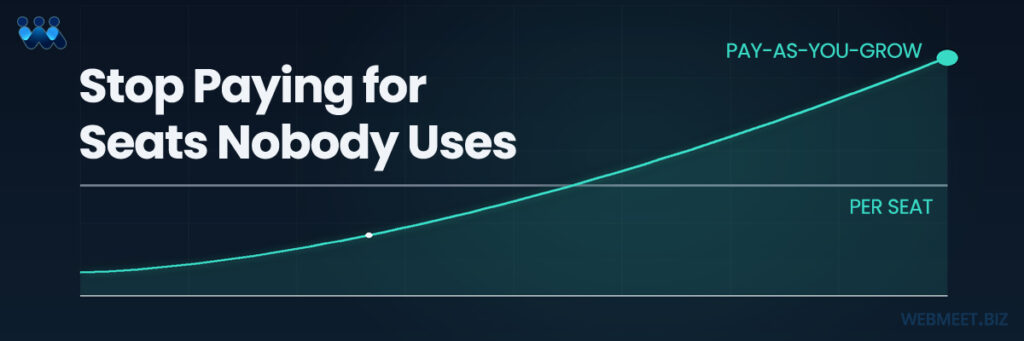
The mechanics make the difference concrete. Distributor members (Hosts) pay your company directly for their branded meeting room subscription — not WebMeet®, and not a third-party processor sitting between you and your customer. Your company then pays AWS hosting fees in its own AWS account and remits a fixed, per-Host royalty to WebMeet® for platform support and ongoing development. That royalty is fixed by tier, with no term commitments required, and it steps down as adoption grows — so your margin per Host improves as you scale, rather than staying flat or being eroded by a revenue-share cut. For the full unit-economics breakdown — pricing tiers, margin at scale, and the underlying numbers — see our white label video conferencing SaaS piece.
WebMeet® doesn’t process payments or store card data at all. All billing runs through your company, on your terms, through your own merchant relationship. Combined with deployment inside your own AWS account, your company has exclusive access to and control over the underlying data — not shared custody, not vendor visibility, full ownership.
Software Escrow: Ownership You Can Add Whenever You’re Ready
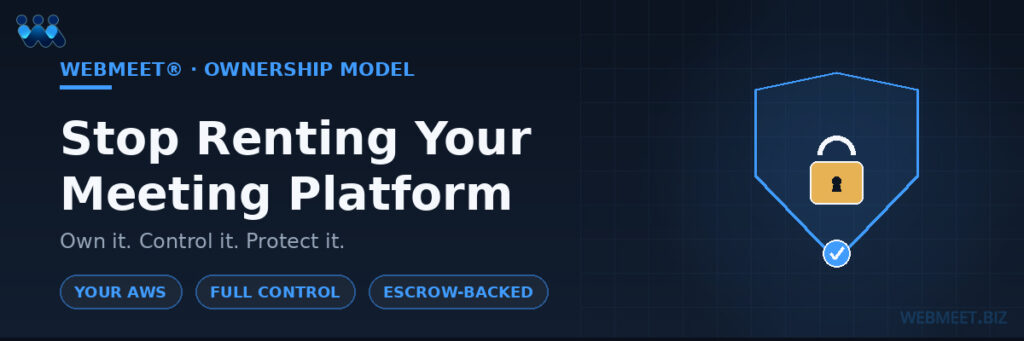
Ownership isn’t a one-time decision made at signup — it’s something you can reinforce over time. Optional software escrow is available to licensees whenever they choose to add it, protecting long-term business continuity and platform ownership if anything were ever to change in the vendor relationship. That’s a meaningfully different posture than a typical reseller deal, where continuity depends entirely on the goodwill and stability of whoever you’re reselling for. Here, the protection is something your company controls the timing of, not something bundled in — or absent — by default.
The Product Layer That Makes Ownership Worth Having
None of this matters unless the platform itself is worth owning. A generic video call is a commodity — nobody pays extra for a link that looks like every other meeting link. What makes a branded meeting room genuinely valuable is the control layer underneath it: hosts can manage an entire room at once — muting mic and video, limiting chat, restricting file sharing — or grant individual permissions to one specific guest mid-meeting, whether that’s microphone access, camera rights, or the ability to present slides or video. Those rights can be revoked just as instantly as they’re granted, without disrupting the meeting or requiring technical support.
That level of control is what turns “a video call” into “a managed presentation environment” — the kind of experience a distributor is genuinely willing to pay for, because it makes them look more capable and professional than a free Zoom link ever could.
Economics That Reward Ownership, Not a Revenue Share
The unit economics reflect the same structure. As paid Host adoption grows, the royalty owed to WebMeet® steps down by tier, which means net margin per Host improves the larger your organization gets — the opposite of what typically happens under a revenue-share reseller arrangement, where the vendor’s cut usually stays fixed regardless of your growth. Your company sets the retail price to distributors, and the difference between what they pay and what you remit in AWS costs and royalty is retained revenue, collected directly by your organization. For the ownership and infrastructure model underneath all of this, see our white label web meeting platform overview.
What This Means for Corporate Leadership
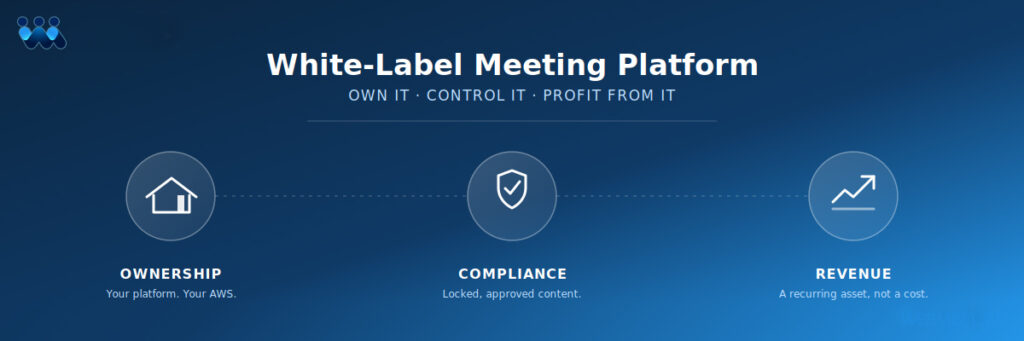
If a reseller video conferencing platform was what brought you here, it’s worth recalibrating the ask. What your organization actually needs — and what WebMeet® is built to provide — isn’t a markup on someone else’s product. It’s your own brand, your own billing relationship, exclusive control of your own data, infrastructure deployed in your own AWS account, and the option to add escrow-backed continuity whenever you’re ready for it. That’s not reselling a platform. That’s owning one.
Schedule a strategy call today, and let’s talk about what a branded web meeting solution could do for your business. Click the Book a Strategy Call button below.